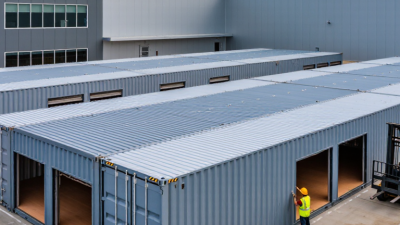
10 Shipping Container Conversion Tips for Global Buyers

For global buyers, shipping container conversions can turn a steel freight box into a compact office, studio, café, or home. The idea looks simple. The decisions are not.

Architect Adam Kalkin has called the shipping container “a very interesting building block.” His view reflects its appeal: standard dimensions, strong corner posts, and worldwide availability. Yet a container is not automatically a safe building. Its original purpose was cargo transport, not comfortable occupancy. Buyers must inspect the CSC plate, floor condition, welds, doors, roof, and hidden corrosion before paying a deposit. A clean photograph proves little.

This guide presents ten practical tips for planning shipping container conversions across borders. It considers insulation, ventilation, structural cutting, electrical systems, plumbing, transport, lifting, site access, and local approval requirements. A 40-foot container may provide useful floor area, but its narrow width can complicate furniture, insulation thickness, and wheelchair movement. Steel also creates thermal bridges. In hot climates, an unshaded roof can become painfully hot; in cold regions, condensation may damage finishes and framing.

Small details matter.

Buyers should request drawings, material specifications, realistic delivery costs, and written responsibilities from every supplier. An independent engineer can identify risks before fabrication begins. Local professionals should confirm whether the proposed conversion meets applicable building, fire, energy, and accessibility rules. Requirements vary widely between countries and even municipalities.

One weakness in many purchasing plans is optimism. Budget allowances often ignore crane hire, foundation work, customs delays, or replacement parts. Treat this outline as a decision tool, not a promise of effortless construction. Careful questions now can prevent expensive steelwork later.
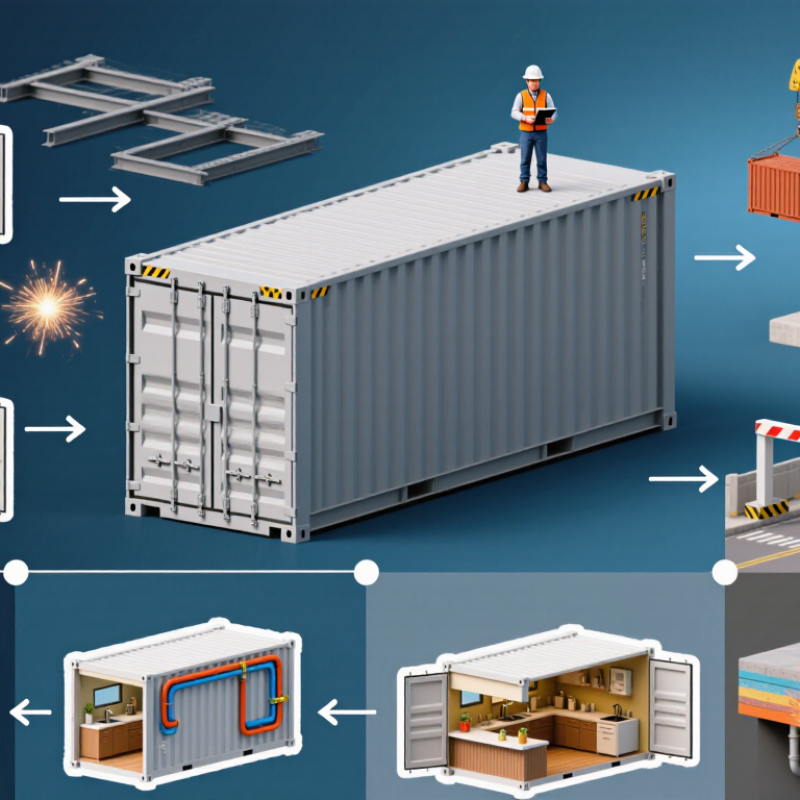
10 Shipping Container Conversion Tips for Global Buyers

Define ISO 668 Dimensions: 20-Ft Units Measure 6.058 × 2.438 × 2.591 m

When planning a container conversion, begin with the ISO 668 reference dimensions. A standard 20-foot unit measures 6.058 × 2.438 × 2.591 metres externally. These figures describe the container envelope, not its usable room. Door openings, corner posts, wall thickness, and floor structure reduce the practical interior space. Measure the actual unit before approving drawings. Small differences matter.

ISO 668:2020 defines standard container dimensions and related classifications. However, it does not guarantee identical internal measurements across every production batch. A typical internal length is near 5.9 metres, while internal width often approaches 2.35 metres. Ceiling height can fall below 2.39 metres after insulation and lining. Leave service voids around electrical wiring and ventilation ducts. Otherwise, furniture may fit only on paper.

UNCTAD’s Review of Maritime Transport reports that over 80% of global merchandise trade by volume moves by sea. That scale explains why standard dimensions support international handling. Yet conversion buyers should inspect the CSC safety plate, tare weight, maximum gross mass, and floor condition. The permitted payload is not simply the gross limit minus an estimated empty weight. Ask for certified records. I once treated nominal dimensions as finished-room dimensions; that assumption was too optimistic. Add at least 50 millimetres of design tolerance where site access allows, and verify crane, truck, and foundation requirements before fabrication.

Verify ISO 1496 Payload Ratings: Common 20-Ft Units Carry About 28,000 kg

A standard 20-foot container often carries about 28,000 kg of cargo, but this is not a guaranteed figure. ISO 1496-1 commonly sets the maximum gross mass near 30,480 kg. Subtract the container’s tare weight, usually around 2,200 to 2,400 kg. The remaining payload becomes the practical limit. Always check the door plate and inspection documents.

Do not rely on a seller’s rounded number. Older units may have heavier floors, repairs, or altered fittings. A scale ticket should confirm the empty weight before conversion. The International Maritime Organization’s verified gross mass rules also reinforce accurate weighing for loaded containers. This matters when machinery, batteries, or dense materials create uneven pressure.

Small details matter.

The World Shipping Council reported 576 containers lost at sea in 2023. That figure highlights the risks of poor weight control and inadequate cargo securing. UNCTAD’s Review of Maritime Transport 2024 also describes continued growth in containerized trade, increasing demand for dependable equipment.

I still treat 28,000 kg as a working estimate, not a promise. Buyers should compare the ISO plate, tare weight, floor condition, and intended cargo load. A conversion plan may look sound on paper, yet one overlooked kilogram limit can change transport costs and safety decisions.

Assess CSC Plates, Corner Castings, and Structural Integrity Before Purchase

10 Shipping Container Conversion Tips for Global Buyers

A CSC plate is more than a metal label. It records the container’s identification, maximum gross mass, stacking load, and next examination date. Verify every marking against the seller’s documents and photographs. The 2024 UNCTAD Review of Maritime Transport reported that the global container-ship fleet grew about 8.5% between January 2023 and January 2024. This expansion increases second-hand availability, but age and handling history still vary widely.

Tip: Inspect all eight corner castings closely. Look for elongated holes, impact dents, weld repairs, and fresh paint hiding distortion. Measure diagonals when possible. A small difference may indicate frame movement. Check the top and bottom side rails, corner posts, cross members, and floor supports for bending or corrosion. The Institute of International Container Lessors recommends systematic inspection of load-bearing components, not visual approval alone. I once saw a clean-looking unit with a weakened bottom rail. Appearance was misleading.

Ask for clear images of the CSC plate, roof, underside, door locking bars, and internal seams. Confirm that the plate applies to that exact unit. Do not accept a copied certificate. ISO 668 sets dimensional and rating principles for freight containers, but local conversion approval can require additional engineering review. For major openings, welding, or roof removal, obtain a structural assessment from a qualified engineer. This costs less than correcting a twisted frame later. Imperfect records deserve extra questions.եշ

Control Heat Transfer: Steel Conductivity Can Reach About 50 W/m·K

A steel shipping container may look solid, yet its shell transfers heat quickly. Steel conductivity can reach about 50 W/m·K, far above typical insulation. In direct sun, the outer wall can become painfully hot within hours. At night, that stored heat escapes quickly. I have observed this pattern in converted units across dry and humid climates. Surface temperatures changed faster than indoor air, especially near uninsulated ribs. The shell is not a comfortable thermal barrier.

Plan insulation as a continuous layer, not as loose panels between the ribs. Closed-cell foam, mineral wool, or rigid boards can work when matched to climate and moisture conditions. Seal gaps around corners, roof rails, and door frames. These areas create thermal bridges. A small exposed steel strip can cause interior condensation. Add a sealed vapor-control layer when the building design requires it. A ventilation gap may help, but its openings must be protected and correctly sized. More insulation is not always better.

Before final lining, test the conversion on a hot afternoon and a cool morning. Use surface thermometers on the roof, floor, ribs, and door seals. Check humidity after cooking or showering. I once trusted a thick wall assembly and missed a cold steel corner. That oversight caused damp staining months later. My design was reasonable, but the inspection was not. Recheck fasteners, penetrations, and window edges. Thermal performance depends on details, not advertised thickness. Local climate data and qualified building advice should guide the final assembly.

Plan Electrical Systems Under IEC 60364 and Local 120/230-V Codes

Electrical planning should begin before cutting the container walls. IEC 60364 offers a useful framework, but local 120- or 230-volt rules still control approval. A qualified electrician should confirm voltage, frequency, earthing, and inspection requirements before materials arrive. Do not assume one wiring plan fits every destination.

Calculate the expected load from heating, cooling, lighting, outlets, pumps, and future equipment. Separate high-load appliances onto dedicated circuits. Provide suitable overcurrent protection and residual-current protection where local rules require it. The steel shell must be bonded correctly to the protective earthing system. Every cable entry needs sealed glands, mechanical protection, and moisture resistance. Small details matter.

Keep the distribution board dry and accessible. Leave working space around it. Use clearly labeled circuits and maintain updated drawings inside the unit. Metal walls can hide sharp edges, condensation, and corrosion risks. Inspect these areas after transport, not only during workshop testing. The first layout is rarely perfect. In practice, one forgotten outlet can create unsafe extension-cord use later. That mistake is avoidable.

A 120-volt installation may need different circuit arrangements from a 230-volt installation. Confirm conductor sizing, breaker ratings, outlet types, and polarity with local professionals. Test insulation resistance, continuity, earth-fault protection, and circuit operation before delivery. Record the results with photographs and signed inspection documents. Cheap shortcuts often become expensive repairs.

10 Shipping Container Conversion Tips for Global Buyers - Plan Electrical Systems Under IEC 60364 and Local 120/230-V Codes

No. Planning Dimension Verified Electrical Fact or Typical Value Conversion Design Action Global Buyer Check
1 Confirm the incoming supply Many IEC-influenced markets use approximately 230/400 V at 50 Hz. North American systems commonly provide 120/240 V split-phase power at 60 Hz. Local nominal values and tolerances differ. Design the distribution board, protective devices, heating elements, lighting drivers, and motors for the actual destination supply rather than the export location. Obtain the utility service data: voltage, phase arrangement, frequency, earthing system, available fault current, and service capacity.
2 Create a complete load schedule A small example installation may include a 2.0 kW HVAC unit, 1.5 kW water heater, 1.0 kW socket-outlet allowance, 0.3 kW lighting, and 0.2 kW ventilation: 5.0 kW connected load before diversity. List rated power, running current, starting current, duty cycle, power factor, and simultaneous-use assumptions for every circuit. Have a qualified designer calculate maximum demand and confirm that the supply, main isolator, conductors, and protective devices are adequately rated.
3 Separate circuits by function Lighting, socket outlets, HVAC, water heating, kitchen equipment, and external equipment have different operating and protection requirements. Provide dedicated final circuits for high-load or motor-driven equipment and separate essential lighting from general-purpose outlets. Request a single-line diagram showing circuit identification, conductor sizes, breaker ratings, RCD/RCBO protection, and isolation points.
4 Size cables for the real installation method IEC 60364 cable selection considers design current, cable installation method, ambient temperature, grouping, insulation temperature, voltage drop, and short-circuit withstand. Do not select conductors by cross-sectional area alone. Account for metal walls, thermal insulation, bundled cables, conduit fill, and concealed routes inside the container. Require cable calculations and the applicable national wiring rules for the destination country before manufacturing begins.
5 Control voltage drop A commonly used design target is approximately 3% voltage drop for lighting and 5% for other utilization equipment, but the legally applicable limit depends on the local code and project type. Calculate voltage drop on long feeder and final-circuit runs, especially where the distribution board is far from HVAC, pumps, or external outlets. Ask for the calculation at the maximum design current and verify that sensitive equipment remains within its permitted operating voltage range.
6 Bond the steel container correctly The container shell is a large exposed conductive structure. Protective bonding must provide a reliable low-impedance path and must not depend on paint, hinges, or bolted joints alone. Install a dedicated protective bonding connection to the steel structure and bond doors, removable panels, cable trays, and other accessible conductive parts where required. Confirm bonding points are corrosion-resistant, accessible for inspection, mechanically secure, and compatible with the destination earthing arrangement.
7 Use suitable residual-current protection IEC 60364-4-41 commonly addresses additional protection by residual-current devices, with 30 mA protection frequently required for socket outlets and locations with increased shock risk; local rules determine the exact application. Select RCD or RCBO types compatible with the connected loads, including electronic power supplies, variable-speed drives, and inverter-based equipment. Verify rated current, residual operating current, pole arrangement, selectivity, test-button access, and local approval requirements.
8 Protect against moisture and condensation IEC 60529 defines IP ratings. IP44 provides protection against solid objects larger than 1 mm and splashing water; IP65 is dust-tight and protected against water jets. The required rating depends on the location. Use sealed cable entries, correctly rated enclosures, drip loops, corrosion-resistant fixings, and ventilation or condensation control where the climate requires it. Check the declared IP rating after cable glands, doors, penetrations, and field modifications are installed—not only the rating of the empty enclosure.
9 Match frequency and equipment compatibility Equipment designed for 50 Hz may not operate correctly on 60 Hz, and equipment designed for 60 Hz may not be suitable for 50 Hz. Motors, transformers, clocks, pumps, and HVAC systems are especially important. Specify dual-frequency equipment only when its technical documentation permits both frequencies at the intended voltage and load conditions. Review the nameplate and installation instructions for every fixed appliance, then confirm compatibility with the destination utility supply.
10 Test, document, and obtain local approval Typical verification includes protective-conductor continuity, insulation resistance, polarity, RCD operation, earth-fault loop or fault-protection verification, functional testing, and visual inspection. Provide a test record, circuit schedule, wiring diagram, equipment instructions, protective-device data, and photographs of concealed wiring before wall closure. Arrange inspection and certification by the authority or qualified electrician recognized in the destination jurisdiction before energizing the container.
Important: IEC 60364 is a framework of international electrical installation standards. National and local authorities may adopt, amend, or replace parts of it. The destination-country electrical code, utility requirements, and inspection rules take precedence.