2026 Top Snap Button Kit Types for Global Buyers
The right Snap Button Kit can make a garment easier to assemble, repair, and use. Yet global buyers face a crowded mix of sew-on snaps, prong-style fasteners, spring snaps, and plastic resin options. Small parts matter. A kit may look complete, but mismatched cap sizes, thin setting tools, or unclear instructions can slow production and create avoidable waste.
The market context is substantial. Textile Exchange’s Materials Market Report 2024 estimates that global fiber production reached 124 million tonnes in 2023 and could rise to 160 million tonnes by 2030. That report does not forecast snap-button demand, but it highlights the scale of the material supply chain these components serve. McKinsey and The Business of Fashion’s State of Fashion reports also track shifting sourcing priorities, including cost pressure and supply-chain resilience. For buyers, those pressures make specifications and supplier checks more than paperwork.
Fit comes first. This guide compares kit types by fastening mechanism, fabric compatibility, tool quality, pack contents, and likely use—from lightweight shirts to bags and heavier denim. It also considers sample testing, size consistency, and replacement parts, since a low unit price can hide extra setup costs. Not every kit fits. Product descriptions can be incomplete, and real fabric may behave differently from a sample swatch. Use the comparisons as a starting point, then test the chosen kit on the intended material before placing a larger order.
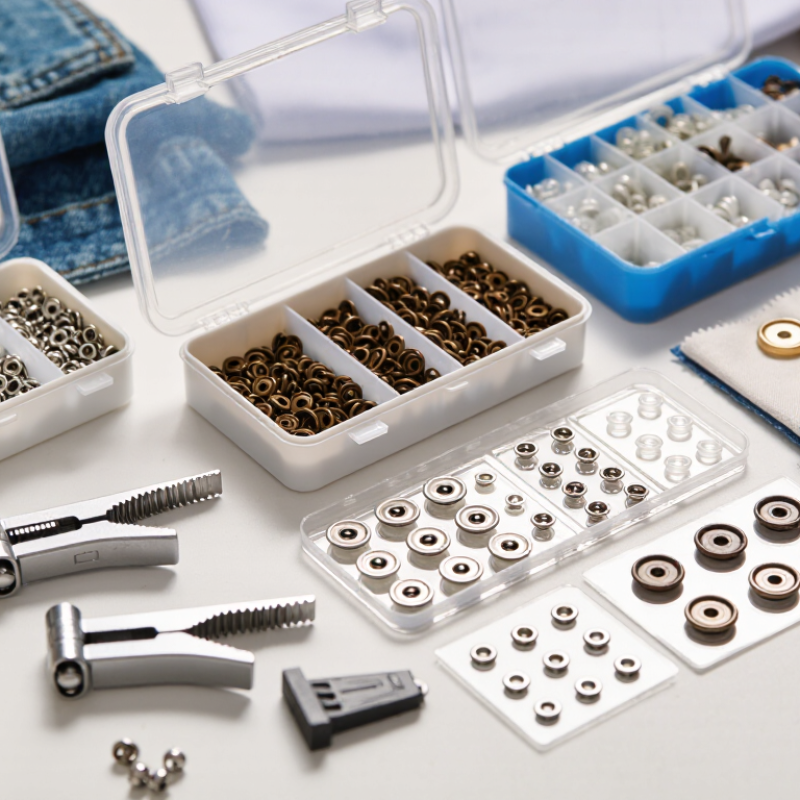
Snap Button Kit Anatomy: 4 Parts—Cap, Socket, Stud, and Post
A snap button kit contains four small parts: cap, socket, stud, and post. Each has a separate role. The cap forms the visible front, often with a smooth or textured finish. Behind it, the socket receives the stud and creates the familiar snap closure. A clean click is useful, but it is not the only sign of a good fit. Loose fabric, misaligned parts, or uneven pressure can make a fastener wobble or fail to close securely.
The stud fits into the socket, while the post anchors the stud through the fabric. In many common kits, the cap and socket sit on one side of the material; the stud and post sit on the other. Exact shapes can vary, so check the kit’s instructions before setting parts. Test one snap on a fabric scrap first. It reveals whether the post length suits the material thickness and whether the closure feels too tight. Small differences matter. A thin cotton panel may need a gentler setting than layered canvas. Even careful hands can misalign a part, so inspect the first finished snap before repeating the process.
Kit Types by Fastener Design: Prong, Ring-Spring, Sew-On, and Jean Snaps
Prong snaps use pointed posts that pass through the fabric and lock into a socket. They suit fast assembly on stable, medium-weight materials, but delicate cloth can tear around the puncture. Ring-spring snaps use a spring ring inside the socket to hold the stud. They offer a firm, clean closure for jackets and bags; check opening force on the actual fabric stack, not just a loose sample. Small details matter. Textile Exchange’s Materials Market Report 2024 estimates global fiber production reached 124 million tonnes in 2023 and could reach 160 million tonnes by 2030. That scale makes consistent hardware selection and testing important across varied materials.
Sew-on snaps attach through small holes around the rim, avoiding a press and piercing the fabric body. They work well for delicate garments and repairs, though hand placement can vary. Jean snaps use a post and cap designed to anchor through heavier denim. Choose post length to match the fabric thickness, and test the setting pressure: too much can flatten the cap or mark the cloth. A snap may feel secure on one sample, then loosen after laundering. That is an easy detail to miss. For global purchasing, request material-specific pull and cycling tests, and record the fabric weight, post length, and installation method with each sample.
| Snap Type | Fastener Design | Typical Attachment Method | Common Materials | Typical Cap Diameter | Common Applications | Buyer Checks |
|---|---|---|---|---|---|---|
| Prong snaps | Prongs on the cap or socket pass through the fabric and are secured by a mating component. | Installed with a compatible hand press or snap-setting tool and matching dies. | Brass, steel, stainless steel, and assorted plated metals. | About 9.5–15 mm | Light- to medium-weight clothing, baby garments, accessories, and craft projects. | Match the prong length to the fabric thickness; verify component compatibility and finish requirements. |
| Ring-spring snaps | A metal ring in the socket provides spring tension to hold the stud in place. | Set through the material using a press or hand tool with the correct dies. | Brass, steel, stainless steel, and plated alloys. | About 10–15 mm | Shirts, jackets, bags, uniforms, and other garments needing a firm, reusable closure. | Check spring action, pull strength for the intended fabric, component set, and corrosion resistance. |
| Sew-on snaps | Two separate components, each with sewing holes, are stitched directly to the fabric. | Hand-sewn or machine-sewn; no setting press is normally required. | Metal or plastic. | About 6–21 mm | Delicate garments, knitwear, costumes, cushions, and projects where a setting tool is unsuitable. | Choose a size and material suited to the fabric; check hole placement and sewing access. |
| Jean snaps | A decorative cap, socket, stud, and post form a sturdy snap assembly designed for heavier materials. | Installed through denim or similar fabric with a compatible press or setting tool. | Brass, steel, zinc alloy, and other metals, often with a plated or coated finish. | About 15–20 mm | Denim jackets, jeans, workwear, bags, and other medium- to heavyweight products. | Confirm post length for the fabric stack, cap style, setting-die fit, and finish durability. |
Size note: Diameter ranges are indicative examples of commonly encountered sizes, not a universal standard. Actual sizes, component designs, materials, and tool requirements vary by product specification.
Material Options: Brass, Stainless Steel, and 304-Grade Components
Brass, stainless steel, and 304-grade components each suit different snap button priorities. Brass offers a warm finish and workable forming characteristics, making it useful for decorative garments and accessories. Stainless steel is valued for durability, but “stainless” alone does not identify its grade. Grade 304 is a specific stainless option, commonly described as 18/8 for its approximate chromium and nickel content. The World Stainless Association reported 58.4 million metric tons of global stainless crude steel production in 2023, showing the material’s broad industrial use—not proving that every snap button is suitable for every environment.
For buyers, check which parts use the named material: cap, socket, stud, and spring may differ. A 304 cap paired with another alloy’s spring is not an all-304 set. Ask suppliers for material specifications and test results, especially when buttons face frequent washing, sweat, or coastal humidity. Corrosion resistance still depends on surface finish, construction, and exposure. Small details matter. Brass can tarnish, while stainless steel can still stain in harsh, chloride-rich conditions. A polished sample alone may hide these differences.
Tips: Test a sample on the actual fabric. Open and close it repeatedly, then inspect the finish and fastening force. One overlooked point: fabric thickness can affect performance as much as metal choice.
Size and Use Mapping: Match Cap Diameter to Fabric and Application
Cap diameter is a useful starting point, not a complete sizing rule. A 9.5 mm cap gives a neat, low-profile finish on lightweight cotton shirts, bibs, and small accessories. Caps around 12–15 mm are easier to handle on jackets, bags, and medium-weight canvas. Small caps suit detail.
Heavy denim or layered fleece may need larger caps and longer posts, but diameter alone cannot ensure a secure closure. Match post length to the compressed fabric thickness, and use compatible socket and stud components. A post that is too short may not set firmly; one that is too long can deform or loosen. Test on fabric scraps first.
For bulk sourcing, note the cap diameter, fabric layers, and intended application in the sample brief. Check closure force by hand, then open and close each sample repeatedly. A snap that feels secure on a flat swatch may struggle near seams or folded hems. I would not assume one size fits every fabric finish; coatings can change the fit slightly. Record the results before ordering at scale.
Global Corrosion Testing: ISO 9227 NSS Uses 5% NaCl at 35°C
For global buyers comparing snap button kits, ISO 9227 neutral salt spray (NSS) provides a repeatable corrosion screen. The test uses a 5% sodium chloride solution at 35°C under controlled conditions. This gives suppliers and buyers a shared basis for comparing samples. Small details matter. A cap, socket, stud, spring, and coating edge may react differently.
Ask for the exposure duration, sample preparation, and assessment criteria alongside the test result. Check whether the report covers individual components or fully assembled buttons. Look for clear photographs and notes on visible corrosion, especially around folds, cut edges, and moving parts. A clean-looking cap alone may not tell the whole story.
NSS is useful, but it does not predict an exact number of years in real use. Wear, sweat, storage, and local climate can change performance. One limitation is easy to overlook: test results only help when the acceptance standard is agreed in advance. Buyers should compare like with like, and question results that omit test details. That extra check takes time. It can prevent a confident decision based on incomplete evidence.
2026 Top Snap Button Kit Types for Global Buyers
Global Corrosion Testing: ISO 9227 NSS uses 5% sodium chloride (NaCl) at 35°C.
The chart shows the NSS spray-solution pH range of 6.5–7.2. The 5% NaCl concentration and 35°C chamber temperature are test conditions, not a predicted service life or a guarantee of corrosion resistance. Compare snap-button materials and finishes using an agreed test duration and evaluation criteria.
Article Source:
Get a quote
Get a quote
Read More
Accept AllReject AllCustomise
Privacy Overview
| Cookie | Duration | Description |
|---|---|---|
| cookielawinfo-checkbox-advertisement | 1 year | Set by the GDPR Cookie Consent plugin, this cookie records the user consent for the cookies in the "Advertisement" category. |
| cookielawinfo-checkbox-analytics | 11 months | This cookie is set by GDPR Cookie Consent plugin. The cookie is used to store the user consent for the cookies in the category "Analytics". |
| cookielawinfo-checkbox-functional | 11 months | The cookie is set by GDPR cookie consent to record the user consent for the cookies in the category "Functional". |
| cookielawinfo-checkbox-necessary | 11 months | This cookie is set by GDPR Cookie Consent plugin. The cookies is used to store the user consent for the cookies in the category "Necessary". |
| cookielawinfo-checkbox-others | 11 months | This cookie is set by GDPR Cookie Consent plugin. The cookie is used to store the user consent for the cookies in the category "Other. |
| cookielawinfo-checkbox-performance | 11 months | This cookie is set by GDPR Cookie Consent plugin. The cookie is used to store the user consent for the cookies in the category "Performance". |
| CookieLawInfoConsent | 1 year | CookieYes sets this cookie to record the default button state of the corresponding category and the status of CCPA. It works only in coordination with the primary cookie. |
| viewed_cookie_policy | 11 months | The cookie is set by the GDPR Cookie Consent plugin and is used to store whether or not user has consented to the use of cookies. It does not store any personal data. |
| Cookie | Duration | Description |
|---|---|---|
| _cs_c | 1 year 1 month | The cookie is used by Content Square to save the user consent to be tracked. |
| Cookie | Duration | Description |
|---|---|---|
| _cs_id | 1 year 17 days 20 hours 13 minutes | This cookie is used to store the ContentSquare's user identifier ID. This is a persistent cookie and expires after 13 months. |
| _cs_s | 1 hour | This cookie is used to store the number of page's viewed by a visitor within the session for ContentSquare's solution. |
| _ga | 1 year 1 month 4 days | Google Analytics sets this cookie to calculate visitor, session and campaign data and track site usage for the site's analytics report. The cookie stores information anonymously and assigns a randomly generated number to recognise unique visitors. |
| _ga_* | 1 year 1 month 4 days | Google Analytics sets this cookie to store and count page views. |
| _gcl_au | 3 months | Google Tag Manager sets the cookie to experiment advertisement efficiency of websites using their services. |
| Cookie | Duration | Description |
|---|---|---|
| test_cookie | 15 minutes | doubleclick.net sets this cookie to determine if the user's browser supports cookies. |
| Cookie | Duration | Description |
|---|---|---|
| _cs_root-domain | session | Description is currently not available. |
| _cs_same_site | session | Description is currently not available. |