Top Stainless Steel Meat Hooks for Global Buyers?
Choosing the right Stainless Steel Meat Hooks is a practical decision for meat processors, but specifications can be easy to overlook. Hook shape, wire diameter, working load, and finish all affect handling and service life. A hook that looks sturdy may not suit a particular carcass, rail, or workflow. Small details matter.
Global buyers also need clear product information. Confirm the stainless steel grade, dimensions, surface finish, and load guidance with the supplier. Ask how the hooks are manufactured and inspected, and request documentation that supports the stated material and performance claims. For food-processing environments, cleanability and corrosion resistance deserve careful attention. Still, a polished finish alone proves very little.
This guide outlines the features buyers can compare when evaluating meat hooks, from single-point and multi-point designs to construction quality and packaging. It also considers supplier communication, sample checks, and the value of matching a product to its actual use. Requirements can differ by facility and destination, so buyers should verify applicable food-contact, workplace, and import requirements with qualified sources. That step takes time. It can prevent costly mismatches.
No single hook is best for every operation. Comparing measurable details, rather than relying on photos or broad claims, gives purchasing teams a more dependable starting point. Some specifications may remain unclear; that is a reason to ask better questions, not to assume.
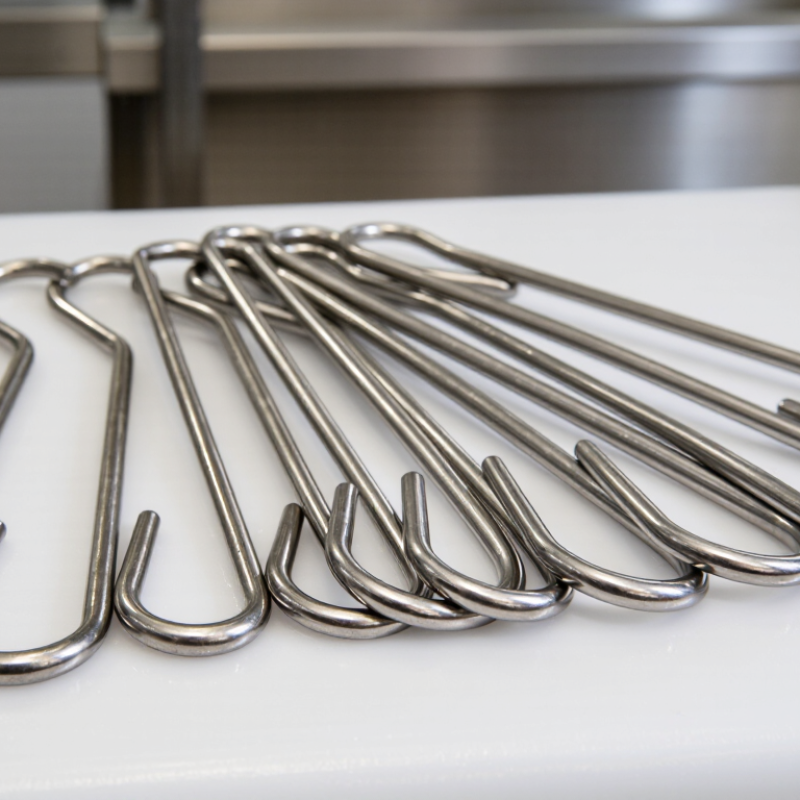
Types and Uses of Stainless Steel Meat Hooks
Stainless steel meat hooks serve different handling needs. S-hooks are simple and quick to reposition on rails. Gambrel hooks spread weight across two points, helping stabilize larger cuts. Single- and double-prong hooks suit smaller portions, while trolley hooks move carcasses along overhead tracks. Choose the shape for the load and workflow, not appearance alone. A polished surface is easier to inspect, but rough welds or tight joints can still trap residue.
The OECD-FAO Agricultural Outlook 2024–2033 projects global meat production to grow 12% by 2033 compared with the 2021–2023 average. That scale makes durable, cleanable handling equipment important across processing and storage. For general food-handling areas, buyers often consider 304 stainless steel; more corrosive or chloride-rich environments may warrant 316. Confirm the material specification, rated load, weld quality, and cleaning instructions with the supplier. A thick hook may look reassuring, but thickness alone does not prove safe capacity.
Tips: Match the hook throat to the rail, and leave clearance between hanging cuts. Inspect bends and welds for cracks or burrs before use. Do not assume every stainless hook resists every cleaning chemical; test the chosen routine against the supplier’s guidance.
How Hook Design Affects Load Capacity and Handling
Top Stainless Steel Meat Hooks for Global Buyers?
How Hook Design Affects Load Capacity and Handling
Hook capacity depends on more than steel grade. Wire diameter, bend radius, opening size, and the way force travels through the curve all matter. A tight bend or sharp transition can concentrate stress, while a broad, even curve may distribute force more smoothly. A closed eye can help secure a hook to a rail; an open design can speed loading, but may be easier to dislodge. Small details. They change handling.
ASTM A240/A240M specifies a minimum tensile strength of 515 MPa for Type 304 plate. That figure is not a safe working load for a finished meat hook. Forming, welds, dimensions, and testing affect the final rating. Buyers should request the hook’s rated capacity and test documentation, rather than estimate capacity from steel data alone. For hooks used in lifting applications, ASME B30.10 offers relevant guidance on hook inspection and use. Still, the exact application matters.
Tips: Match hook throat size to the product and rail, and check that the point is smooth, not burred. Compare hooks under real handling conditions: gloves, cold rooms, and wet surfaces can change grip. It is easy to overlook this. A polished finish may help cleaning, but it does not replace routine inspection for bending, cracks, or loose connections.
Stainless Steel Grades, Finishes, and Corrosion Resistance
Top Stainless Steel Meat Hooks for Global Buyers?
For meat hooks exposed to washdown, humidity, and salt, stainless steel grade matters as much as load capacity. Grade 304 suits many general-purpose applications and resists routine moisture well. Grade 316 contains molybdenum, offering better resistance to chlorides and salty conditions, though it is not corrosion-proof. Grade 430 may cost less, but it generally offers less protection in persistently wet environments. A mirror-bright hook can still have poor corrosion resistance if its alloy or fabrication is unsuitable.
Tips: Check the stated steel grade, not just “stainless steel.” Ask about finish and weld quality. Smooth, polished surfaces are easier to clean; scratches, rough welds, and tight crevices can retain residue and moisture. One detail buyers sometimes miss is the hook’s contact point: a small damaged area may discolor first. It happens.
Match the finish to actual cleaning conditions. Passivation can help restore the protective surface after fabrication, but it cannot compensate for poor material selection or neglected care. Rinse off salt and cleaning chemicals, then dry hooks when practical. Inspect bends and welds regularly for pitting, rust-colored marks, or surface damage. These checks take time, and they are easy to postpone; that is often where problems begin.
Safety Standards and Quality Checks for Global Buyers
For global buyers, stainless steel meat hooks should be assessed against the food-contact and workplace requirements of the destination market. There is no single certificate that proves suitability everywhere. Check the issuing body, test scope, material grade, and document validity. A mill test report can help confirm whether the steel is 304 or 316, but it does not replace finished-product inspection. Keep batch records linked to purchase orders. That detail matters later.
Inspect each sample under bright light. Look for rough welds, burrs, deep scratches, and gaps that can trap residue. Run a gloved finger carefully along non-pointed edges, then check the hook’s tip protection and shape. Smooth surfaces help cleaning, but appearance alone proves little. Ask for passivation or corrosion-test records when relevant, and compare them with the product specification. Check load capacity using a stated method and realistic working conditions. A hook that bends under a controlled test is a warning.
Request consistent samples from more than one production batch. Verify dimensions, wire thickness, finish, and packaging against the agreed specification. Ask how the supplier prevents mixed steel grades and protects hooks from moisture during shipping. Photos are useful, but not enough. I would also review a recent inspection report or arrange independent sampling for a large order. Small inconsistencies happen; they should be recorded, not waved away.
How to Compare Suppliers, Pricing, and Shipping Options
Top Stainless Steel Meat Hooks for Global Buyers?
Comparing suppliers starts with the hook’s actual specifications, not a low unit price. Check stainless steel grade, wire diameter, hook opening, weld quality, and load rating. Ask whether the rating applies to a single hook under controlled conditions. Real loads may shift during handling. Request clear photos or a sample, and confirm that dimensions match your racks and processing setup. Small differences matter.
Compare quotes on the same basis: quantity, packaging, inspection, and payment terms. A cheaper offer may exclude protective packaging or provide limited quality documentation. Ask suppliers how they check for sharp edges, surface defects, and consistent measurements. I would still verify these details on a sample; paperwork alone cannot show every finishing issue. Shipping costs also depend on carton size, order volume, destination, and delivery terms. Request estimated transit time and clarify who handles export documents and any import charges.
Tips: Get a written specification sheet. Compare landed cost, not just unit price. Ask for carton dimensions and gross weight before booking freight. Build in time for sample approval; schedules can slip, and planning around a perfect delivery date is risky.