China Top 10 Electrical Socket Manufacturers for Buyers
Choosing an Electrical Sockets manufacturer takes more than comparing prices or browsing polished product photos. A socket may look simple, yet its contacts, insulation, terminal design, and finish affect how it performs in daily use. Buyers should examine rated voltage and current, compatible plug types, material specifications, quality-control records, and available test documentation. Ask for product samples, too. A clear catalog is useful, but it cannot replace a close inspection.
Michael Faraday, the pioneering scientist whose work helped shape electrical engineering, wrote, “Nothing is too wonderful to be true, if it be consistent with the laws of nature.” His words are not about sockets specifically, but they offer a fitting engineering principle: claims should be supported by evidence. For buyers, that means checking specifications and documents rather than relying on broad promises of safety, durability, or certification.
This guide introduces ten Chinese Electrical Sockets manufacturers for buyers assessing product range, production capability, customization, communication, and quality assurance. Some suppliers may suit large-volume orders; others may offer more flexibility for a smaller project. Confirm current details directly with each manufacturer, since product lines and documentation can change. Small parts. Serious choices. And one useful reminder: a supplier’s responsiveness matters, but it does not prove product quality. Compare the evidence, ask precise questions, and leave room to reconsider a promising first impression.
Electrical Socket Basics and Common Product Categories
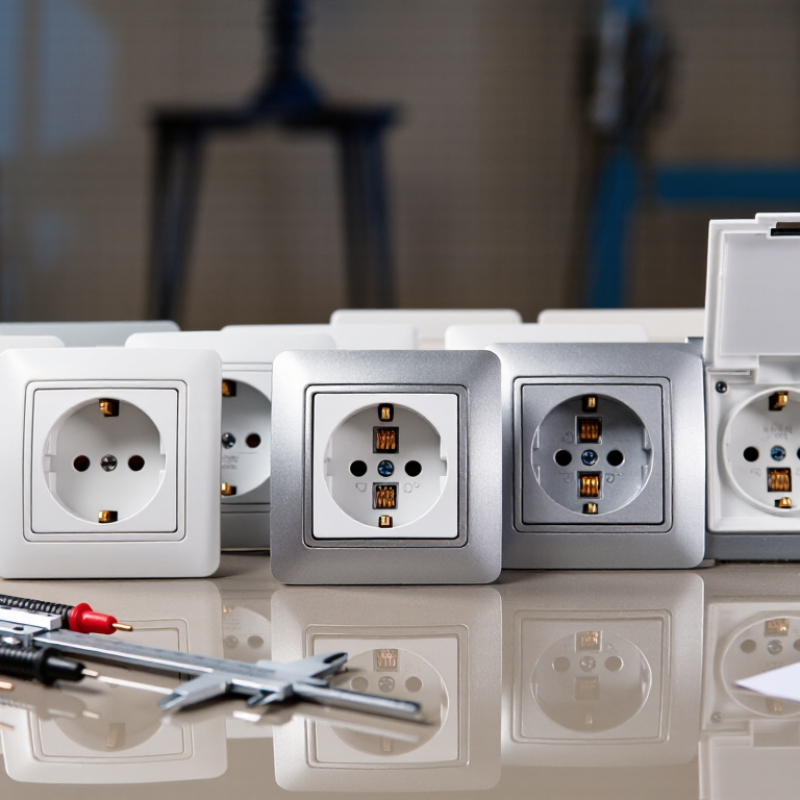
Electrical sockets connect appliances to a building’s wiring, but their ratings and internal features matter more than faceplate style. Check the rated voltage, current, grounding method, terminal design, and compatibility with the destination market’s plug system. NFPA’s 2022 Home Electrical Fires report estimated 46,700 U.S. home fires involving electrical failure or malfunction each year from 2015 to 2019.
A loose terminal can overheat behind a tidy-looking wall plate.
Common categories include standard wall receptacles, switched sockets, USB-integrated models, weather-resistant outdoor sockets, and higher-current industrial outlets. Tamper-resistant shutters add protection in some residential applications. Modular designs combine functions, though extra features can complicate installation and inspection.
Buyers should compare contact materials, enclosure heat resistance, wiring capacity, and tested ratings—not just the number of ports. Product categories and accepted configurations vary by region, so one specification does not fit every market.
Tips
Match socket ratings to the intended load and local wiring conditions. Ask for test reports and installation instructions, then verify the documents against the exact model. Do not assume a familiar-looking socket is compatible. That detail is easy to miss.
Safety Standards and Certifications for Chinese Electrical Sockets
For buyers comparing Chinese electrical sockets, certification is a practical safety check, not a substitute for product testing. Confirm whether the exact socket model falls within China’s current CCC certification catalogue. If it does, request a valid certificate and check that its model, factory, and product category match your order. A certificate for a similar-looking outlet may not cover the unit being supplied.
Ask which standards the product was tested against. GB/T 2099.1 covers general requirements for household plugs and socket-outlets, while GB 1002 specifies dimensions for commonly used Chinese plugs and sockets. Requirements can vary by product type and market. For export orders, check the destination country’s rules too; an IEC test report alone does not automatically replace local approval. Review test evidence for grounding continuity, temperature rise, insulation, and shutter operation. Small details matter.
Request recent reports from a qualified laboratory and compare the tested sample with production drawings. A loose grounding contact or cracked faceplate can be missed in a tidy document set. Inspect samples under realistic loads, and ask how production batches are checked. Paperwork can look perfect. It still deserves a second look. Some suppliers may resist sharing detailed records; treat that as a reason to ask clearer questions, not as proof of failure.
How Buyers Can Assess Electrical Socket Manufacturers
When comparing electrical socket manufacturers, look beyond catalog photos and unit prices. Ask how contact materials, housing plastics, and terminal screws are specified and checked. Request a recent test report, then confirm its model numbers match the socket you plan to buy. Small details matter. A polished sample can hide variation between production batches.
Evaluate the factory’s inspection process, not only its quality claims. Ask how workers verify terminal torque, dimensions, and electrical continuity during production. If possible, review records from several lots and ask what happens when a result falls outside limits. Check whether the supplier can trace material batches and explain its corrective-action process. A factory visit helps, but one clean production day does not prove consistent output.
Discuss installation conditions, order volume, packaging needs, and delivery schedules in writing. For samples, check fit, clamping, and repeated operation under conditions relevant to your project. Confirm which market-specific certifications apply, and verify documents with the issuing body when practical. Communication is evidence too. Slow answers are not automatically a warning, yet vague responses about failures or design changes deserve follow-up.
Electrical Socket Manufacturer Assessment: Common Rated-Current Benchmarks
Use these common socket-system ratings as a reference when checking whether a manufacturer’s products suit your target market. They are not manufacturer scores: confirm each product’s rating, applicable national standard, certification, and intended use before purchasing.
China’s Top 10 Electrical Socket Manufacturers at a Glance
China’s electrical socket sector includes manufacturers focused on household fittings, commercial installations, and customized components. A useful top-ten comparison should show more than product photos. Check each supplier’s socket types, rated voltage and current, materials, production capacity, and export experience. These details help buyers match a factory to a real project.
Look for clear technical documents, sample availability, and consistent quality checks. Ask how contacts, terminals, and insulation are inspected during production. A polished catalog is helpful, but it cannot confirm performance by itself. Factory capabilities also vary, even among suppliers offering similar products. Treat rankings as a starting point, not proof of suitability. Some details may be harder to verify than expected.
Tips: Request samples and test them against your own specifications before placing a large order. Confirm lead times, packaging, customization limits, and after-sales support in writing. Ask for relevant test reports, and check that model numbers match the documents. Small mismatches can cause delays. A little extra checking is worthwhile.
Comparing Suppliers, Product Options, and Purchasing Requirements
Comparing electrical socket suppliers takes more than checking unit prices.
Buyers should match each product to its intended market and installation, then confirm rated voltage, current, grounding design, terminal type, and mounting dimensions.
A socket that looks suitable in a catalogue may not fit an existing wall box. Small details matter.
Product options can include different outlet layouts, safety shutters, faceplate materials, colors, and wiring methods.
Ask suppliers for current technical sheets, test reports, and clear product photographs. Request samples when dimensions or finish quality are uncertain.
Check how firmly terminals hold a standard wire, whether the faceplate sits flat, and whether markings remain readable.
Not always easy to compare.
Purchasing requirements deserve equal attention.
Confirm minimum order quantities, sample charges, production lead times, carton counts, packaging protection, and procedures for handling defects.
Ask how changes to materials or specifications are communicated between orders. Documentation should identify the tested model, not just a similar product family.
Comparisons are rarely tidy; a low quotation may exclude packaging or inspection.
I would record assumptions beside each price, since overlooked details can distort the comparison.
Where possible, review supplier quality records and arrange an independent inspection before a large shipment.
Article Source:
Get a quote
Get a quote
Read More
Accept AllReject AllCustomise
Privacy Overview
| Cookie | Duration | Description |
|---|---|---|
| cookielawinfo-checkbox-advertisement | 1 year | Set by the GDPR Cookie Consent plugin, this cookie records the user consent for the cookies in the "Advertisement" category. |
| cookielawinfo-checkbox-analytics | 11 months | This cookie is set by GDPR Cookie Consent plugin. The cookie is used to store the user consent for the cookies in the category "Analytics". |
| cookielawinfo-checkbox-functional | 11 months | The cookie is set by GDPR cookie consent to record the user consent for the cookies in the category "Functional". |
| cookielawinfo-checkbox-necessary | 11 months | This cookie is set by GDPR Cookie Consent plugin. The cookies is used to store the user consent for the cookies in the category "Necessary". |
| cookielawinfo-checkbox-others | 11 months | This cookie is set by GDPR Cookie Consent plugin. The cookie is used to store the user consent for the cookies in the category "Other. |
| cookielawinfo-checkbox-performance | 11 months | This cookie is set by GDPR Cookie Consent plugin. The cookie is used to store the user consent for the cookies in the category "Performance". |
| CookieLawInfoConsent | 1 year | CookieYes sets this cookie to record the default button state of the corresponding category and the status of CCPA. It works only in coordination with the primary cookie. |
| viewed_cookie_policy | 11 months | The cookie is set by the GDPR Cookie Consent plugin and is used to store whether or not user has consented to the use of cookies. It does not store any personal data. |
| Cookie | Duration | Description |
|---|---|---|
| _cs_c | 1 year 1 month | The cookie is used by Content Square to save the user consent to be tracked. |
| Cookie | Duration | Description |
|---|---|---|
| _cs_id | 1 year 17 days 20 hours 13 minutes | This cookie is used to store the ContentSquare's user identifier ID. This is a persistent cookie and expires after 13 months. |
| _cs_s | 1 hour | This cookie is used to store the number of page's viewed by a visitor within the session for ContentSquare's solution. |
| _ga | 1 year 1 month 4 days | Google Analytics sets this cookie to calculate visitor, session and campaign data and track site usage for the site's analytics report. The cookie stores information anonymously and assigns a randomly generated number to recognise unique visitors. |
| _ga_* | 1 year 1 month 4 days | Google Analytics sets this cookie to store and count page views. |
| _gcl_au | 3 months | Google Tag Manager sets the cookie to experiment advertisement efficiency of websites using their services. |
| Cookie | Duration | Description |
|---|---|---|
| test_cookie | 15 minutes | doubleclick.net sets this cookie to determine if the user's browser supports cookies. |
| Cookie | Duration | Description |
|---|---|---|
| _cs_root-domain | session | Description is currently not available. |
| _cs_same_site | session | Description is currently not available. |