What Is the Best EPS Casting Pattern Mould for 2026?
Choosing the best Eps Casting Pattern Mould for 2026 requires more than comparing prices or surface appearance. Foundries must examine dimensional stability, vapor evacuation, coating compatibility, machining accuracy, and repeated production performance. A pattern that looks precise on a workshop bench may still create gas defects during pouring.
Market evidence supports this broader view. Grand View Research identifies continued growth in the expanded polystyrene market, driven by construction, packaging, and industrial applications. Mordor Intelligence also highlights rising demand for lightweight foam products and improved manufacturing efficiency. These trends matter because casting suppliers increasingly need moulds that reduce trimming, improve repeatability, and support faster pattern preparation.
John Campbell, a widely recognized casting researcher and author, stated, “The quality of a casting is determined by the quality of the liquid metal.” His observation remains highly relevant to lost-foam production. A high-quality Eps Casting Pattern Mould cannot correct poor melt cleanliness, unstable pouring temperatures, or inadequate gating design. It can, however, support better control.
The practical details are easy to see. Edges should remain sharp after handling. Vent paths must be clear. The foam must not crumble around a 2-millimetre rib. Small failures become expensive defects.
There is no universal winner.
The best choice depends on alloy, casting size, production volume, coating system, and operator experience. Some purchasing guides overemphasize density and ignore tool maintenance. That is a weakness worth questioning. For 2026, the strongest selection process will combine supplier testing, documented tolerances, trial castings, and independent quality records.
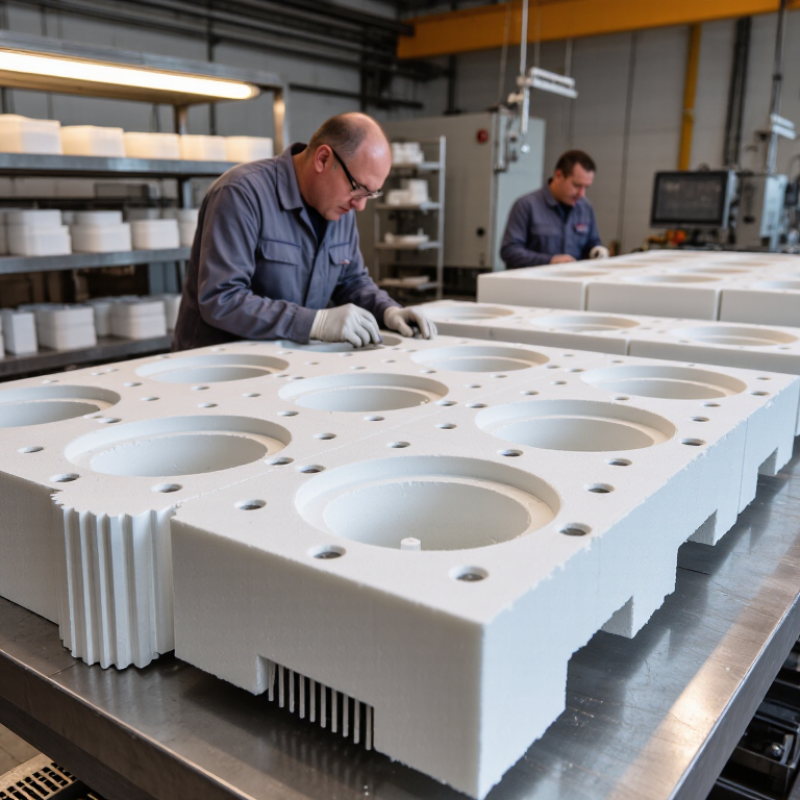
EPS Casting Pattern Mould Fundamentals: 16–30 kg/m³ EPS Density
What Is the Best EPS Casting Pattern Mould for 2026?
The best EPS casting pattern mould begins with controlled density, not a fashionable machine specification. For lost-foam casting, 16–30 kg/m³ EPS offers a practical working window. EUMEPS technical data places many molded EPS applications within similar density ranges. Lower-density foam fills cavities quickly and produces less residue. It also crushes more easily during handling. That trade-off matters.
At 16–20 kg/m³, use reinforced pattern sections and careful bead fusion. Thin ribs can deform near the moulding gate. At 22–26 kg/m³, patterns usually balance stiffness, machinability, and cleaner evaporation. At 27–30 kg/m³, the surface feels harder and dimensional stability may improve. However, higher density can increase gas generation during pouring. Too much gas, too late.
ISO 845 and ASTM D1622/D1622M define apparent-density measurement methods for cellular plastics. Measure finished patterns, not only raw bead certificates. A 0.5 kg/m³ difference can affect venting and coating absorption. Foundry trials reported in recent technical literature repeatedly connect foam density, coating permeability, and casting-defect risk. The result is not universal. Pouring temperature, coating thickness, vacuum level, and aluminium grade still change performance. I would test three densities beside one another, using identical mould geometry. Record pattern mass, collapse time, surface defects, and final dimensions. Small mistakes become obvious.
Pattern Design Variables: 10–40× Bead Expansion and 0.5–2.0% Shrinkage
What Is the Best EPS Casting Pattern Mould for 2026?
Pattern Design Variables: 10–40× Bead Expansion and 0.5–2.0% Shrinkage
Selecting an EPS casting pattern mould for 2026 demands more than a smooth cavity. In production trials, bead expansion often ranges from 10× to 40×. The final value depends on density, steam pressure, and aging time. A mould designed for 20× beads may respond poorly to 35× material. Sharp corners can soften, while thin ribs become fragile. We measure cavity temperature at several points, not only near the steam inlet. Small thermal differences create visible density bands.
Shrinkage deserves equal attention. A practical design window is 0.5% to 2.0%. The correct allowance depends on bead grade, mould temperature, cooling time, and geometry. For a 500-millimeter section, 1% shrinkage equals roughly 5 millimeters. That is not minor. Draft angles, wall thickness, and local bosses can change the final result. Trial patterns with witness marks and removable inserts reveal movement early. Records should include density, expansion history, and steaming intervals.
Some teams assume a wider expansion range makes one mould more versatile. That assumption is not always right. Excessive flexibility can weaken venting control and produce inconsistent surfaces. I have seen a pattern pass a room-temperature check, then fail after thermal cycling. The lesson is uncomfortable: calculated shrinkage is only a starting point. Engineers should compare three castings, inspect corners, and revise allowances when evidence disagrees. A reliable EPS mould remains stable when material behavior becomes inconvenient.
What Is the Best EPS Casting Pattern Mould for 2026?
Pattern Design Variables: 10–40× Bead Expansion and 0.5–2.0% Shrinkage
The chart shows reference design points within the stated EPS process ranges. Bead expansion is expressed as a multiple of the original bead volume, while shrinkage is expressed as a percentage. Final mould settings should be validated through bead conditioning, steam-chest trials, tooling geometry, and dimensional inspection.
Mould Material Selection: 680–750°C for Aluminium and 1,350–1,450°C for Iron
Aluminium normally pours between 680–750°C. A fine refractory coating can protect the sand while preserving permeability. Alumina or selected silica systems may work well at this range. The coating should dry evenly across corners, ribs, and the sprue entrance. Excessive thickness can trap gases and create folds, pinholes, or rough surfaces. Small details matter.
Iron requires stronger resistance at 1,350–1,450°C. Alumina, zircon, and chromite-rich materials deserve evaluation. The best choice depends on alloy composition and moulding conditions. The coating must resist rapid heating, chemical attack, and flaking. It must still allow gases to escape steadily. Do not trust a flat test coupon alone. Complex patterns behave differently. Measure coating thickness, moisture, permeability, and filling time during trials.
A useful warning remains: higher refractoriness does not guarantee better castings. Poor drying or high viscosity can defeat a suitable material. Review each defect, then adjust one variable at a time.
Dimensional Accuracy Benchmark: ISO 8062-3 Casting Tolerance Grades CT8–CT10
What Is the Best EPS Casting Pattern Mould for 2026?
Dimensional Accuracy Benchmark: ISO 8062-3 Casting Tolerance Grades CT8–CT10
For 2026, the best EPS casting pattern mould is not simply the lightest or cheapest option. It must support stable dimensions across repeated castings. ISO 8062-3 grades CT8 to CT10 provide a practical benchmark for evaluating accuracy. CT8 represents tighter control, while CT10 allows more dimensional variation. The selected grade should match the component’s function, size, and machining allowance.
In production trials, EPS bead density, mould temperature, and steam pressure strongly affect pattern stability. A small change can shift a hole location or alter a wall thickness. Small errors accumulate.
A rigid mould structure helps maintain repeatability during filling and handling. Venting also matters, especially around deep ribs and narrow corners. These details reduce incomplete fusion and local deformation.
Measurement should include critical lengths, flatness, hole centers, and casting reference surfaces. A coordinate measuring machine can compare results against the CT8–CT10 requirement. However, the mould alone cannot guarantee the final tolerance. Shrinkage, coating thickness, sand movement, and metal temperature remain influential. Reality is messier. I would validate the tool with several trial patterns, not one successful sample. Recording actual variation is more reliable than trusting a theoretical drawing. If CT8 proves unstable, a controlled CT9 target may deliver better production consistency.
2026 Selection Matrix: Part Geometry, Alloy, Output Volume, and Tooling Life
Choosing the best EPS casting pattern mould for 2026 depends on four measurable conditions: geometry, alloy, output volume, and tooling life. Complex ribs, deep pockets, and thin walls require split moulds, accurate vents, and controlled bead expansion. Simple housings can use fewer parting lines, reducing flash and assembly time. According to ASM Handbook guidance on lost-foam casting, dimensional control depends heavily on pattern density, coating permeability, and foam filling consistency.
Alloy selection changes the mould decision. Aluminum alloys demand stable thermal control and clean evacuation paths. Iron alloys create higher thermal loads and may require stronger coatings and more durable mould surfaces. The International Aluminium Institute reports that recycled aluminum uses roughly 5% of the energy required for primary aluminum. That figure strengthens the case for recycled-alloy production, but melt cleanliness still affects surface defects and pattern design.
Output volume separates prototype tooling from production tooling. For fewer than 1,000 patterns annually, low-cost aluminum tooling may be practical. Higher volumes justify hardened inserts, replaceable vents, and automated bead filling. A mould expected to exceed 100,000 cycles needs wear testing, dimensional records, and planned refurbishment. The U.S. Department of Energy’s Advanced Manufacturing Office identifies process repeatability as a major driver of manufacturing energy efficiency. The matrix is not perfect. Operators still report unexpected shrinkage, especially around heavy sections. Trial castings remain necessary. Track cycle count, cavity temperature, foam density, and defect location before approving the final mould.
What Is the Best EPS Casting Pattern Mould for 2026? - 2026 Selection Matrix: Part Geometry, Alloy, Output Volume, and Tooling Life
Selection guide for evaporative-pattern casting. Ratings assume competent pattern design, controlled bead pre-expansion, suitable refractory coating, and stable molding-sand conditions.
| Pattern Mould / Production Route | Best-Fit Part Geometry | Recommended Alloy Families | Typical Output Volume | Dimensional Capability | Pattern Tooling Life | Typical Lead Time | Relative Tooling Cost | Key Advantages | Main Limitations | 2026 Selection Verdict |
|---|---|---|---|---|---|---|---|---|---|---|
| CNC-machined EPS block pattern | Large or irregular castings; low-to-medium complexity; open surfaces; prototypes and engineering changes | Aluminum alloys, gray iron, ductile iron, carbon steel, low-alloy steel | 1–100 castings per design revision | Typically about ±0.5–1.5 mm, depending on part size, cutter, bead density, coating, and casting process control | Usually one-time or short-run use; the EPS pattern is consumed during pouring | Approximately 2–10 working days after approved CAD data | Low | Fast design changes, no permanent pattern mould, suitable for oversized parts, economical for prototypes | Machining marks may transfer to the casting; lower productivity for repeated small parts; dimensional drift can occur during storage | Best for prototypes, replacement parts, and large low-volume castings |
| Steam-chest moulded EPS pattern | Repeatable shapes with ribs, bosses, pockets, and moderate undercuts designed for controlled bead filling and ejection | Aluminum and magnesium alloys; gray and ductile iron; selected steel applications with suitable refractory systems | About 500–50,000 castings per year | Typically about ±0.3–0.8 mm for a well-controlled pattern process; final casting tolerance also depends on alloy and mold conditions | Commonly tens of thousands to hundreds of thousands of pattern cycles, depending on aluminum-tool design, steam, abrasion, and maintenance | Approximately 4–12 weeks, including tooling design, machining, trial shots, and correction | Medium to high | High repeatability, good surface definition, efficient cycle times, consistent bead density, and strong suitability for serial production | Higher initial investment; venting, ejection, bead filling, and shrinkage compensation must be engineered carefully | Best general-purpose choice for stable medium- to high-volume production |
| Hybrid moulded-and-machined EPS pattern | Complex production geometry requiring molded repeatability plus local machining for revisions, interfaces, or tight features | Aluminum alloys, ductile iron, gray iron, and selected steel castings | About 100–10,000 castings per year | Typically about ±0.3–0.8 mm before casting; tighter local features may require machining after casting | Generally tens of thousands of cycles for the permanent mould, with consumable EPS pattern inserts | Approximately 5–14 weeks | Medium | Balances repeatability and flexibility; useful when a family of related parts shares a common base geometry | More process coordination than either a fully machined or fully molded route; interface errors may arise between molded and machined areas | Best compromise for changing programs and medium-volume families |
| Segmented EPS mould with replaceable inserts | Large housings, manifolds, engine blocks, pump bodies, and parts with optional bosses or interchangeable features | Aluminum, iron, and steel alloys when the coating and gating system are matched to thermal demand | About 50–5,000 castings per year | Typically about ±0.5–1.0 mm before casting; joint alignment and insert location are critical | Permanent base tooling can support many thousands of cycles; replaceable inserts reduce full-tool replacement requirements | Approximately 6–16 weeks | Medium to high | Supports product variants, simplifies maintenance, reduces the cost of localized design changes, and suits large patterns | Parting lines, insert gaps, and assembly tolerances can affect surface quality and dimensional consistency | Best for modular product platforms and large variable castings |
| High-density EPS or bead-optimized moulded pattern | Fine ribs, thin walls, small radii, detailed lettering, and surfaces where pattern strength and finish are important | Aluminum, magnesium, gray iron, and ductile iron; steel requires carefully validated refractory and filling practice | About 1,000–100,000 castings per year | Typically about ±0.25–0.7 mm for the pattern, subject to bead fusion, density uniformity, and casting shrinkage | Often tens of thousands to hundreds of thousands of cycles for the permanent mould | Approximately 6–16 weeks | Medium to high | Improves pattern handling strength, edge retention, surface detail, and resistance to deformation during coating and handling | Higher material and processing cost; excessive density can slow gas evacuation and requires process validation | Best for detailed, thin-wall, and appearance-sensitive castings |
| Large-format additive or robotic EPS pattern | Very large components, topology-optimized forms, one-off tooling, complex cores, and geometries difficult to split conventionally | Aluminum and iron alloys; steel applications require thermal, coating, and gas-evolution validation | 1–50 castings per design | Typically about ±1.0–3.0 mm before finishing, depending on machine resolution, bead or pellet deposition, and post-machining | No durable production mould; the deposited pattern is generally consumed after one pour | Approximately 1–15 working days after model preparation | Low for low volume | Enables rapid production of very large or highly complex patterns with minimal hard tooling | Surface stepping, anisotropy, bead bonding, gas generation, and dimensional accuracy require careful control | Best for very large, highly customized, or rapidly iterated castings |
| Fine-detail EPS mould with integrated ceramic or polymer inserts | Local wear zones, thin sections, deep cavities, controlled interfaces, and features requiring additional dimensional stability | Aluminum, iron, and selected steel alloys; insert compatibility with pouring temperature must be verified | About 500–20,000 castings per year | Typically about ±0.3–0.8 mm in the pattern, with local accuracy governed by insert placement and thermal expansion | Permanent mould commonly supports tens of thousands of cycles; inserts may have shorter replacement intervals | Approximately 8–18 weeks | High | Protects critical details, improves local wear resistance, and can reduce machining allowance on selected surfaces | More expensive and complex to design; thermal compatibility, bonding, and gas permeability must be checked | Best when local detail or wear performance justifies additional tooling complexity |
Important engineering checks: pattern density, bead fusion, venting, coating permeability, dimensional shrinkage, draft and ejection strategy, gating, risering, pouring temperature, alloy fluidity, and expected gas evolution should be validated through trials before production release.
Article Source:
Get a quote
Get a quote
Read More
Accept AllReject AllCustomise
Privacy Overview
| Cookie | Duration | Description |
|---|---|---|
| cookielawinfo-checkbox-advertisement | 1 year | Set by the GDPR Cookie Consent plugin, this cookie records the user consent for the cookies in the "Advertisement" category. |
| cookielawinfo-checkbox-analytics | 11 months | This cookie is set by GDPR Cookie Consent plugin. The cookie is used to store the user consent for the cookies in the category "Analytics". |
| cookielawinfo-checkbox-functional | 11 months | The cookie is set by GDPR cookie consent to record the user consent for the cookies in the category "Functional". |
| cookielawinfo-checkbox-necessary | 11 months | This cookie is set by GDPR Cookie Consent plugin. The cookies is used to store the user consent for the cookies in the category "Necessary". |
| cookielawinfo-checkbox-others | 11 months | This cookie is set by GDPR Cookie Consent plugin. The cookie is used to store the user consent for the cookies in the category "Other. |
| cookielawinfo-checkbox-performance | 11 months | This cookie is set by GDPR Cookie Consent plugin. The cookie is used to store the user consent for the cookies in the category "Performance". |
| CookieLawInfoConsent | 1 year | CookieYes sets this cookie to record the default button state of the corresponding category and the status of CCPA. It works only in coordination with the primary cookie. |
| viewed_cookie_policy | 11 months | The cookie is set by the GDPR Cookie Consent plugin and is used to store whether or not user has consented to the use of cookies. It does not store any personal data. |
| Cookie | Duration | Description |
|---|---|---|
| _cs_c | 1 year 1 month | The cookie is used by Content Square to save the user consent to be tracked. |
| Cookie | Duration | Description |
|---|---|---|
| _cs_id | 1 year 17 days 20 hours 13 minutes | This cookie is used to store the ContentSquare's user identifier ID. This is a persistent cookie and expires after 13 months. |
| _cs_s | 1 hour | This cookie is used to store the number of page's viewed by a visitor within the session for ContentSquare's solution. |
| _ga | 1 year 1 month 4 days | Google Analytics sets this cookie to calculate visitor, session and campaign data and track site usage for the site's analytics report. The cookie stores information anonymously and assigns a randomly generated number to recognise unique visitors. |
| _ga_* | 1 year 1 month 4 days | Google Analytics sets this cookie to store and count page views. |
| _gcl_au | 3 months | Google Tag Manager sets the cookie to experiment advertisement efficiency of websites using their services. |
| Cookie | Duration | Description |
|---|---|---|
| test_cookie | 15 minutes | doubleclick.net sets this cookie to determine if the user's browser supports cookies. |
| Cookie | Duration | Description |
|---|---|---|
| _cs_root-domain | session | Description is currently not available. |
| _cs_same_site | session | Description is currently not available. |